
CV Joints: CV Axles, CV Boots & Constant Velocity Joint Replacements for FWD and AWD Vehicles
The CV joint constant velocity joint allows front-wheel-drive and all-wheel-drive vehicles to transmit torque through every steering input and suspension movement. When one fails, the clicking through tight corners is rarely anything else. Catch it at the CV boot stage, and you avoid the full joint replacement cost entirely.
CBT Auto Parts supplies CV joints, CV axles, CV boots, and complete CV shaft assemblies as part of our Transmission and Drivetrain Parts range, the same catalogue that covers driveshafts, axles, and universal joints for every other drivetrain layout. OEM-grade and quality aftermarket units are available for passenger, performance, and AWD platforms globally, dispatched from confirmed stock and delivered both locally and internationally.
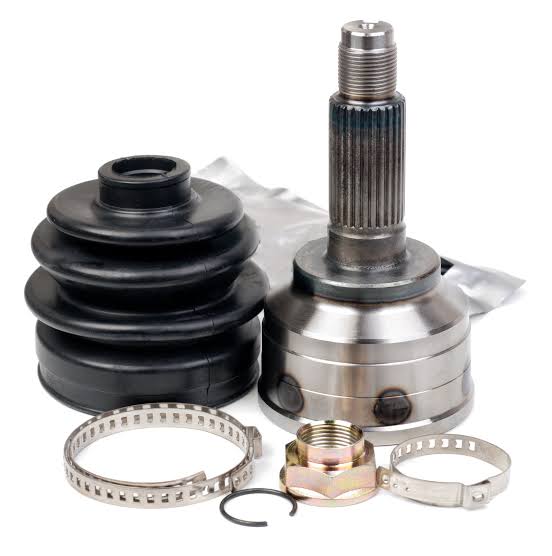
4 products
Showing 1 - 4 of 4 products
What a CV Joint Actually Does and Why It Matters More Than Most Drivers Realise
In a rear-wheel-drive vehicle with a straight longitudinal driveshaft, transmitting torque is straightforward. In a front-wheel-drive or all-wheel-drive vehicle, the driven wheels must simultaneously steer, absorb suspension travel, and transmit torque all at the same time. A standard universal joint cannot do this cleanly at the operating angles involved: it introduces a velocity variation through its rotation cycle that, at large angles, produces vibration and uneven power delivery.
The constant velocity joint solves this through a ball and cage arrangement that maintains a constant output speed regardless of the joint operating angle. This is the engineering achievement that makes front-wheel-drive viable for a passenger vehicle, and it is why the CV joint is present at the inboard and outboard ends of every driven axle shaft in FWD and AWD applications.
The Inner CV Joint
The inner CV joint connects the axle shaft to the differential output on the transmission or transaxle side. It operates through a combination of articulation and plunge,e meaning it must accommodate both angular change and a change in effective shaft length as the suspension moves through its travel. Tripod-type inner joints using three rollers running in corresponding grooves are the dominant design for this position because of their superior plunge capability compared to ball-type joints.
The Outer CV Joint
The outer constant velocity joint connects the axle shaft to the wheel hub and bears the full brunt of the steering angle when the wheel is turned. It articulates through larger angles than the inner joint but does not require plunge capability. Ball-and-cage Rzeppa-type joints are the standard outer CV joint design across the vast majority of passenger vehicle applications, robust, well-documented in the aftermarket, and available across a broad range of platform applications in both OEM and quality aftermarket specification.
The CV Boot: The Cheapest Intervention in the CV Joint Replacement Cost Conversation
Of all the factors that determine whether a CV joint replacement is necessary, the condition of the CV boot is the single most important variable and the one that is entirely within the driver's control to monitor.
The CV boot is a flexible rubber or thermoplastic gaiter that seals the CV joint assembly, retaining the grease that lubricates the internal ball bearings and cage while excluding road contamination, water, and grit. It is the only barrier between a functioning joint and accelerated destruction,n and when it splits, cracks, or detaches at its clamp, the consequence is not immediate,e but it is inevitable.
A torn CV boot allows grease to escape and contamination to enter simultaneously. Within a relatively short operating distance, typically a few thousand kilometres depending on operating conditions, the now-contaminated and under-lubricated joint begins to wear. What started as a CV boot replacement cost becomes a CV axle replacement cost. The labour for accessing the joint is identical in both scenarios; the difference is entirely in what is replaced once access is achieved.
Monitoring CV boot condition at every service interval, looking for grease thrown onto the inner wheel rim, visible tears in the boot material, or loose clamps,s is one of the highest-return maintenance habits available to any FWD or AWD vehicle owner. CBT Auto Parts stocks CV boot replacement kits, individual boot gaiters, and boot clamp sets for applications where the joint itself remains serviceable and only the boot and grease require attention.
CV Joint Failure: A Progression, Not a Single Event
CV joint failure follows a recognisable sequence that gives most drivers meaningful warning time between first symptom and complete failure, provided the symptoms are identified correctly and not attributed to unrelated causes. The progression runs in a consistent pattern across most applications:
Stage one: torn boot, no joint symptoms yet. Grease is visible on the inner wheel rim or suspension components. The joint rotates smoothly and silently. At this stage, a CV boot replacement resolves the situation completely with no joint damage present.
Stage two: contamination has entered, early wear beginning. A faint clicking is audible during slow tight-radius turns, most noticeable in a car park or when performing a U-turn. The sound disappears at higher speeds and in straight-line driving. Repairing a CV joint at this stage through a full CV shaft replacement or individual joint replacement restores normal function before secondary damage develops.
Stage three: established joint wear. The clicking is now present through most cornering inputs, not only tight-radius turns. Vibration may be detectable under hard acceleration. The joint has developed play within the ball and cage assembly that is beyond the boot-and-grease maintenance window. A full CV joint replacement or complete CV axle replacement is the correct course of action.
Stage four: advanced failure approaching separation. A loud continuous clunking is present through all cornering and under acceleration. Vibration is felt through the floor and steering wheel. At this stage, the joint has lost structural integrity and poses a risk of partial or complete separation; on drive, it is also, st and in worst-case scenarios, the separated shaft contacts surrounding components. The vehicle should be removed from service immediately.
The cost of fixing a CV joint increases at each stage of this progression. The time investment in boot condition monitoring between stages one and two is the only intervention required to avoid stages three and four entirely.
CV Joint vs CV Axle vs CV Shaft: Understanding What You Are Actually Ordering
These three terms are used interchangeably in casual conversation, and that creates procurement confusion that results in the wrong component arriving for a job. The distinction is straightforward once it is explained:
CV joint refers specifically to the constant velocity joint assembly itself: the ball cage, inner race, outer race, and balls without the connecting shaft between them. An individual CV joint is the correct order when only the joint has failed, and the shaft tube connecting inner and outer joints remains within specification.
CV axle refers to the complete assembly inner CV joint, interconnecting shaft, and outer CV joint as a single ready-to-install unit. A CV axle replacement is the appropriate order when the shaft tube is damaged, when both joints require replacement, or when the labour context makes a complete assembly replacement more cost-effective than individual joint replacement. The CV axle replacement cost accounts for the full assembly rather than a single joint, but the labour is identical to a single joint replacement since the whole shaft is removed either way.
CV shaft is largely interchangeable with the CV axle in aftermarket usage; both refer to the complete driven axle shaft assembly including its CV joints. The distinction most commonly arises in regional terminology rather than a meaningful technical difference.
At CBT Auto Parts, our listings specify which format each product covers:s individual joint, boot kit, or complete CV shaft assembly, so buyers can confirm the correct procurement before ordering.
CV Joint Replacement Cost: What Drives the Numbers and Where the Value Sits
The volume of search traffic around CV joint replacement cost, CV axle replacement cost, and cost of fixing a CV joint reflects a genuine buyer decision point: buyers comparing DIY versus workshop, individual joint versus complete CV axle, and OEM versus aftermarket before committing to a course of action. Understanding the cost drivers makes that decision straightforward.
Parts cost is the variable buyers have the most direct control over. The constant velocity joint replacement cost for a quality aftermarket CV axle assembly on a high-volume passenger vehicle platform is consistently lower than OEM pricing, often significantly, without a meaningful difference in performance or service life when the aftermarket unit is correctly specified. The CV shaft replacement cost difference between a sub-grade unit and a quality aftermarket unit, however, is a false economy: a poorly manufactured CV axle that fails before the original part's mileage is reached costs more in total than an OEM unit sourced at the first replacement.
Labour cost is the largest component of the total workshop bill and is fixed regardless of which parts option is chosen. This is why sourcing the replacement CV joint or CV axle directly through CBT Auto Parts before presenting the vehicle to a workshop consistently produces a lower total repair cost; the parts value is controlled independently of the workshop's supply margin.
Boot versus full joint is the most important cost decision in this category. The CV boot replacement cost is the lowest-cost outcome at every stage, and the labour to fit a boot is a fraction of the labour to replace a complete joint. Where the joint itself is still tight with no play and no noise, replacing only the CV boot and repacking grease is the correct and most cost-effective decision. Where the joint has developed play, replacing the boot alone is money spent on a joint that is already past saving.
Replacing the CV joint is not always the most expensive outcome; leaving a failed joint in service until it affects the wheel bearing, the differential output seal, or the surrounding suspension components routinely produces a repair bill that dwarfs what the original joint replacement would have cost.
Platform Coverage: CV Joints, CV Axles and CV Boots at CBT Auto Parts
Our CV joint and CV axle inventory covers both individual joints and complete CV shaft assemblies across the passenger, performance, and AWD platforms generating the most consistent replacement volume:
- Front-wheel-drive passenger vehicle CV axles: covering high-volume platforms across Honda, Toyota, Volkswagen, Ford, and Mazda model families where FWD CV axle replacement demand is driven by accumulated mileage and urban driving conditions that cycle the inner joint through its full plunge travel in stop-start traffic constantly
- AWD and 4WD CV shaft assemblies: constant velocity joint demand in AWD platforms differs from FWD in operating angle and torque load. Subaru AWD CV axle applications, for example, place the front CV shaft under drive torque in conditions where both steering angle and suspension compression are simultaneously at their limits, producing accelerated outer joint wear relative to standard FWD use.
- Performance and modified vehicle CV joints: uprated CV joint assemblies for vehicles operating above standard torque outputs are a relevant product category, particularly for modified FWD and AWD platforms where standard constant velocity joint specifications are insufficient for sustained high-torque track or performance driving
- CV boot replacement kits: individual boot gaiters, clamp sets, and grease-inclusive CV boot replacement kits for applications where the joint remains serviceable. Boot kits are the highest-frequency maintenance item within the CV joint product category and are available across a broad platform range.
- Heavy vehicle and commercial CV joint applications: CV joints for light commercial vans, minibuses, and commercial AWD platforms where the operating cycle and load requirements differ significantly from standard passenger vehicle applications
Contact us with your vehicle's make, model, production year, engine code, and drivetrain configuration for a confirmed fitment match on any CV joint, CV axle, or CV boot application.
Repairing a CV Joint: What That Actually Means in Practice
The search queries around repairing a CV joint and fixing a CV joint reflect a practical question buyers are genuinely asking: is there a repair option that stops short of a full joint replacement? The honest answer is a partial yes with a clear boundary.
What can be repaired: A CV joint showing no internal wear, no roughness, no play, no audible click, but with a split or damaged boot can be serviced through a CV boot replacement and grease replenishment. This is the correct repair for a joint where the boot has failed, but the joint itself remains within specification. It is a legitimate, cost-effective repair that extends the joint's service life to its natural end.
What cannot be repaired: A CV joint that has developed internal play, roughness in the ball tracks, pitting on the cage or race surfaces, or an audible click under load cannot be restored through cleaning, regreasing, or any field repair process. The wear is dimensional and structural. The correct course of action is a complete CV joint replacement or a full CV axle replacement, depending on which components are affected.
The clarity of this boundary is what makes the fix-or-replace decision in CV joint maintenance straightforward: if the joint is silent and tight, service the boot. If it is clicking, replace the joint.


