
Universal Joints: U-Joint Replacements, Heavy Duty U-Joints & Drive Shaft U-Joint Components for Cars and Trucks
Every driveshaft and propeller shaft in a rear-wheel-drive or 4x4 vehicle relies on at least two universal joints to do its job. The universal joint is the rotating coupling that allows a driveshaft to transmit torque through changing angles, accommodating the movement of the suspension, the articulation of the drivetrain, and the misalignment between gearbox output and differential input that no vehicle geometry can eliminate entirely. When a U-joint wears out, everything it connects suffers.
CBT Auto Parts supplies universal joint and heavy-duty U-joint replacements as part of our Transmission and Drivetrain Parts range. Our stock covers Ford F150, Ford F250, RAM 2500, Polaris Ranger, and a broad range of passenger, truck, and off-road platforms. OEM-grade units are dispatched from confirmed stock, delivered locally and internationally, with no extended back-order delays on high-demand applications.
25 products
Showing 25 - 25 of 25 products
What a Universal Joint Does and Why Its Failure Affects the Whole Drivetrain
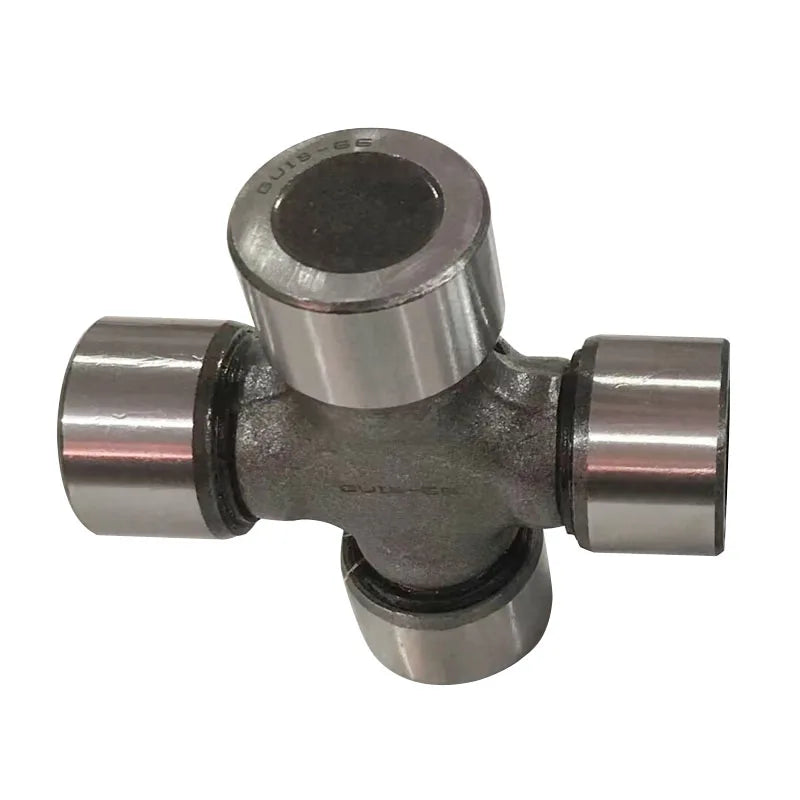
The universal joint, colloquially known as the U-joint, is a deceptively simple component that solves a surprisingly complex mechanical problem. In any rear-wheel-drive or 4x4 drivetrain, the gearbox output shaft and the differential pinion shaft sit at different heights and angles relative to each other. A rigid shaft connecting the two would bind, flex, and ultimately fracture under load. The universal joint introduces a cross-shaped pivot, the trunnion, that allows the shaft to articulate through an angle while continuing to transmit full rotational torque.
Inside every U-joint, four needle roller bearing cups sit at the ends of the trunnion cross, retained by circlips within the yoke ears. These needle bearings are what allow the joint to pivot smoothly in two planes simultaneously. The grease retained within each bearing cup lubricates the needles through their service life, and when that grease degrades, is displaced by contamination, or is never replenished through a grease nipple on serviceable joints, the needle bearings run dry. Dry needle bearings in a high-speed rotating joint under drivetrain load have a predictable and rapid failure sequence.
What makes U joint failure consequential beyond the joint itself is where the resulting vibration and impact loading travel. A worn universal joint transmits shock loads into the driveshaft tube, the differential pinion bearing, the gearbox output shaft bearing, and the transmission mount with every rotation. In high-mileage vehicles where the U joint has been deteriorating unaddressed, secondary damage to these adjacent components is common and significantly increases the total repair cost beyond the U joint replacement itself.
U Joint Failure: Recognising It Early Before Secondary Damage Sets In
The characteristic sound and feel of a worn U joint is one of the more recognisable drivetrain fault signatures once you know what you are listening for. The difficulty is that early-stage U joint wear is easy to attribute to road surface variation or to dismiss as normal drivetrain feel, which delays the repair until the joint has progressed to a state where secondary damage has begun.
These are the indicators that point specifically toward universal joint deterioration:
- A clunk or thud during take-off from rest: the most definitive U-joint symptom. When drivetrain torque is applied from a stationary position, the rotational play that has developed in worn needle bearings produces a single sharp impact as the slack is taken up. The same clunk reappears when lifting off throttle suddenly, as torque direction reverses through the joint.
- Vibration that increases with vehicle speed and is felt through the floor and seat: a U joint that has progressed beyond initial play and into rough needle bearing operation generates a sustained vibration at a frequency proportional to driveshaft rotational speed. Unlike tyre imbalance vibration, which peaks and reduces at certain speed, U-joint vibration typically increases progressively with road speed.
- A squealing or chirping noise from underneath the vehicle at low speed: particularly on vehicles with greaseable U-joints where the lubrication has not been maintained. Dry needle bearings in the early stages of failure produce a high-frequency squeal during the rotation cycle. This sound often disappears after the vehicle has been driven and the joint has warmed up, which makes it easy to overlook until it becomes permanent.
- Visible rust staining around the bearing cup circlip grooves: a universal joint showing surface rust at the bearing cup retention points has either lost its grease seal integrity or has been exposed to water ingestion. Rust at this location is a reliable external indicator of internal bearing degradation without requiring disassembly for confirmation.
- Driveshaft that visibly hops or oscillates at speed: in advanced U-joint failure where the trunnion itself has worn beyond the bearing cup retention, the driveshaft loses its controlled rotational path and oscillates visibly under the vehicle. At this stage, the risk of driveshaft separation is real, and the vehicle should be removed from service immediately.
Greaseable vs Sealed U Joints: Which Type Is in Your Vehicle and Why It Matters
This distinction is one of the most practically important factors in both maintenance scheduling and replacement specification, yet it is frequently overlooked when sourcing a replacement universal joint.
Sealed Universal Joints
A sealed U joint is factory-packed with grease and permanently closed at manufacture; no grease nipple is present, and no external lubrication is intended or possible during the service life of the joint. The advantage of a sealed unit is its maintenance-free operation and its ability to maintain a consistent grease environment across the bearing cup without contamination from external mud, water, or grit ingress through a nipple that was incompletely greased. The limitation is that when the factory grease eventually degrades, which it will, given enough heat cycles and mileage, the joint cannot be revived through servicing, and replacement is the only option. Sealed U joints are the dominant design in modern passenger vehicles and light trucks.
Greaseable Universal Joints
A greaseable U joint incorporates a grease nipple at the centre of the trunnion cross, allowing fresh grease to be injected into the bearing cups at service intervals. When correctly maintained, greased at every service or at the interval specified by the vehicle manufacturer, a greaseable U joint can outlast a sealed unit significantly in high-load or off-road applications where heat and contamination accelerate grease degradation. The practical requirement is that the greasing actually happens. A greaseable U joint that has never been serviced is frequently in worse condition than a sealed unit of equivalent age, because the grease nipple path introduces a contamination route that a sealed joint eliminates entirely. Heavy-duty universal joint applications, particularly in truck driveshafts, propeller shafts, and 4x4 platforms used in demanding off-road conditions, almost universally favour the greaseable design for this reason.
Platform Coverage: Universal Joints at CBT Auto Parts
Our U-joint inventory is structured around the passenger, truck, and off-road platforms that generate the most consistent replacement volume globally:
- Ford F150 universal joint: the F150 is one of the highest-volume U-joint replacement applications in the global aftermarket, used in rear-wheel-drive and 4x4 configurations across a platform that has remained in active production since 1975. Front and rear driveshaft U joints are available across a wide generation range, covering both the solid axle and independent front suspension configurations used across different F150 production years.
- Ford F250 U joint: the F250 Super Duty platform places substantially higher drivetrain loads on its universal joints than a standard passenger truck, driven by the towing, payload, and commercial use cycles this vehicle is designed for. Heavy-duty U joint specification is the appropriate choice for F250 replacement applications, particularly where the vehicle is used regularly at or near rated capacity.
- RAM 2500 U joint: the RAM 2500 heavy-duty platform uses a full-floating rear axle configuration in most variants, and the driveshaft U joints operate under correspondingly high torque loads. Our RAM 2500 U joint range covers both the front and rear driveshaft joint positions across the third and fourth generation platform variants most actively in service.
- Polaris Ranger driveshaft U joints: the Polaris Ranger UTV platform generates consistent U joint replacement demand driven by the off-road and agricultural operating conditions this vehicle is designed for. The combination of articulation angles, low-speed high-torque operation, and frequent exposure to water, mud, and dust makes U-joint service life in Ranger applications considerably shorter than in standard road vehicle use.
- Trucks universal joints: beyond specific platform applications, our heavy duty universal joint range covers a broad selection of commercial truck driveshaft U joint applications where standard passenger vehicle joint specifications are insufficient for the torque, load cycle, and environmental exposure requirements of commercial vehicle operation.
U Joint Repair vs Replacement: Setting the Right Expectation
The term U joint repair is used loosely in the aftermarket, and it is worth establishing what is and is not achievable before deciding on a course of action.
In a greaseable U joint showing early-stage symptoms, a squeal or mild vibration without play, replenishing the grease through the nipple can temporarily restore acceptable operation if the needle bearings have not yet begun to pit or spall. This is maintenance rather than repair in any meaningful sense, and it buys time rather than resolving wear that has already occurred. Once a U joint has developed rotational play, confirmed by gripping the driveshaft at the joint and feeling for movement, greasing will not restore the dimensional precision the bearing cups have lost.
A universal joint replacement is the only correct intervention once play is confirmed. The replacement process involves pressing the old bearing cups out of the yoke ears, cleaning and inspecting the yoke bores for wear or scoring, and pressing new bearing cups in with correct preload. A yoke that is damaged, cracked, or shows significant bore wear from a U-joint that has been running with excessive play requires yoke replacement; alongside the U-joint, continuing with a damaged yoke undermines the new joint immediately.
For the U-joint driveshaft replacement process, the shaft must be correctly phased, meaning the yokes at each end of the shaft must be aligned in the same plane to prevent the velocity variation inherent in each universal joint from compounding into a vibration rather than cancelling out. Incorrect phasing of a two-UU joint driveshaft is a common cause of post-replacement vibration that is often misattributed to a faulty new joint.
For related drivetrain components serviced alongside a U-joint replacement driveshaft assembly, propeller shaft units, and CV joints for front-wheel-drive and AWD applications, our Transmission and Drivetrain Parts range carries all adjacent components within a single catalogue.

