
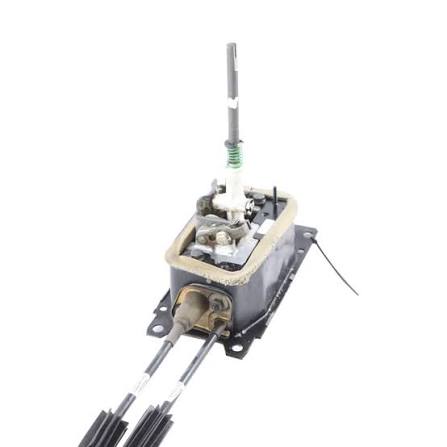
Gear Selectors: Gear Selector Cables, Bush Kits & Automatic Gear Selector Replacements for Cars and Trucks
The gear selector is your direct physical connection to the gearbox, translating every shift input from your hand into a command the transmission executes. When the selector mechanism, cable, or bush fails, shifts become vague, gears refuse to engage, or the lever moves freely with no gearbox response.
CBT Auto Parts supplies gear selector replacements, gear selector cables, gear selector bush kits, and automatic gear selector switch components as part of our Transmission and Drivetrain Parts range. Our coverage includes Ford Falcon, Ford Fiesta, Ford Focus, Mazda 6, and Mercedes Atego, among a wide range of passenger and commercial platforms. OEM-grade and quality aftermarket units ship from confirmed stock to destinations worldwide.

42 products
Showing 25 - 42 of 42 products
The Gear Selection System: Understanding What Sits Between Your Hand and the Gearbox
The gear selector is rarely thought about until it fails, and when it does, it is frequently misdiagnosed as a gearbox problem when the fault lies entirely outside the transmission casing. A vehicle that will not go into gear, or that shifts imprecisely, does not automatically have an internal gearbox fault. In a significant number of cases, the problem originates in the selector mechanism, cable routing, or bush condition components that connect the driver's input to the transmission rather than components that live inside it.
Understanding which part of the selection system has failed determines whether the repair involves a straightforward cable or bush replacement, or whether the gearbox itself requires attention.
Mechanical Rod and Lever Selector Systems
Older passenger vehicles and most light commercial platforms use a direct mechanical linkage between the gear lever and the gearbox selector shafts, a system of rods, pivots, and joints that transmits the lever movement mechanically without cable intermediary. These systems are robust and long-lived, but the pivot joints and connecting rod ends wear over time, introducing play into the selector path that softens the precision of each shift. Adjustment is possible in many applications, but where the joints themselves are worn beyond their adjustment range, replacement of the rod assembly or individual pivot components is required.
Cable-Operated Selector Systems
The gear selector cable is the dominant selector design in modern passenger vehicles, replacing the mechanical rod linkage with one or two flexible cables that transmit lever movement to the gearbox selector mechanism through a sheathed cable assembly. The advantages are significant: cable routing is flexible across engine bay layouts, vibration isolation from the gearbox is improved, and the system accommodates different gearbox positions without complex mechanical linkage geometry. The trade-off is that cables stretch, fray, and develop sheath degradation over time, and when they do, the precise relationship between lever position and gearbox selector movement deteriorates. A gear selector cable replacement restores that relationship at a fraction of the cost of any internal gearbox work.
Electronic and Automatic Gear Selector Systems
Automatic transmissions and modern paddle-shift vehicles increasingly use electronic gear selectors where the lever or switch generates an electrical signal that is interpreted by the transmission control unit rather than physically moving a selector rod or cable. The automatic gear selector switch within these systems, whether a rotary dial, a push-button array, or a conventional lever with position sensors, is a wear component in its own right. Contamination, contact wear, and position sensor failure all produce symptoms that present as transmission faults but originate entirely within the selector switch assembly. Diagnosis must confirm whether the fault is in the electronic selector, the wiring between the selector and the TCU, or the transmission control unit itself before any component is ordered.
What Fails First: Tracing Gear Selector Problems to Their Source
Because the gear selection system spans components from the gear lever through to the gearbox selector shaft, isolating the fault location before ordering parts is critical. The same presenting symptom inability to select a specific gear can originate in four different places depending on the system type and failure mode.
Work through this sequence before concluding which component requires replacement:
- Lever movement with no gearbox response: the lever moves freely through its gates but produces no corresponding shift in the transmission. In a cable system, this almost always means the gear selector cable has separated at one of its end fittings, or the cable has snapped internally within the sheath. In a mechanical rod system, it points to a detached pivot joint or broken selector rod.
- Lever that moves correctly but shifts feel imprecise or require excessive force: the cable or linkage is intact but operating with internal friction, stretch, or misalignment. Gear selector cable stretch is the most common cause in high-mileage cable-operated systems. In mechanical rod systems, worn pivot bushes are the equivalent wear point.
- Specific gear that cannot be selected despite correct lever position: the lever is reaching the correct gate, but the gearbox is not responding. If the fault is consistent and repeatable on a single ratio, the cable adjustment, the gear selector bush at the gearbox end, or the internal shift fork mechanism within the gearbox requires investigation. Shift forks are covered separately in our Transmission and Drivetrain Parts range for buyers whose diagnosis points inward to the gearbox.
- Automatic gear selector that is stuck in a position or will not release from Park: this is typically either an automatic gear selector switch fault, a brake interlock solenoid failure, or a shift lock cable issue rather than a transmission fault. Confirming which of these three is the fault source determines the correct component to order.
Gear Selector Bush: The Smallest Component With the Biggest Effect on Shift Quality
Of all the components within a gear selection system, the gear selector bush is the most frequently overlooked and the most cost-effective to address early. It is also the component whose failure most closely mimics the feel of a worn gearbox, which is why so many bush replacement jobs follow an unnecessary and expensive gearbox investigation.
The selector bush is a small rubber or nylon insert that sits at the connection point between the gear selector cable end and the gearbox selector arm, or between the selector rod and its mounting bracket. Its job is to maintain a precise, zero-play interface at this critical connection point. When the bush degrades through heat cycling, oil contamination, or simple age, the connection develops play. That play feels, from the driver's seat, like a vague and imprecise gearbox. Shift gates feel wider than they should. Engagement feels soft. Neutral is harder to find.
A gear selector bush replacement resolves this in most cases immediately with no internal gearbox work required. The part is inexpensive, and the installation is accessible in most vehicle platforms. It is the correct first intervention on any vehicle presenting with shift vagueness before any gearbox disassembly is considered.
Platform Coverage: Gear Selector Applications at CBT Auto Parts
Our gear selector inventory is structured around the passenger and commercial platforms that generate the most consistent cable, bush, and automatic selector replacement demand globally:
- BA Falcon gear selector cable replacement: the Ford BA Falcon is one of the most actively replaced gear selector cable applications in the Australian market. Both manual selector cable and automatic floor-shift cable variants are covered across the BA, BF, and FG series, which share selector architecture across multiple production years.
- Ford Fiesta gear selector cable replacement: the Ford Fiesta generates consistent selector cable demand across multiple generations, driven by the high volume of this platform in European, African, and Latin American markets. Both the five- and six-speed manual applications are covered in our range.
- Mazda 6 gear selector cable replacement: the Mazda 6 manual and automatic selector cable is a high-frequency replacement across the GG, GH, and GJ chassis generations. Cable end bush kits are also available for applications where the cable sheath remains serviceable but the end fittings have degraded.
- Ford Focus gear selector cable replacement: Ford Focus selector cable demand spans the Mk1 through Mk3 generations across both manual and PowerShift automatic configurations. The PowerShift automatic variant requires confirmation of whether the fault is in the physical selector cable or the electronic selector position sensor before ordering.
- Mercedes Atego gear selector: the Mercedes Atego is a widely deployed medium commercial truck platform used extensively across African, Middle Eastern, and European freight operations. The Atego gear selector covers both the mechanical shift tower and the electronic selector switch variants depending on transmission specification and production year. Commercial selector components for the Atego are sourced to heavy vehicle specification rather than passenger vehicle grade.
- Automatic gear selector switch: across automatic transmission vehicles generally, the selector switch assembly covering position sensor, park interlock, and range indicator functions is available for a range of passenger platforms. Confirm your transmission type and selector design before ordering to ensure the correct switch variant is supplied.
Gear Selector Cable Replacement Cost: Where the Value Actually Sits
For many buyers researching gear selector cable replacement cost, the initial concern is whether the repair is worth doing versus tolerating the fault or exploring a gearbox replacement. The answer is almost always straightforward: a gear selector cable replacement is one of the lowest-cost interventions in the entire drivetrain, and because it eliminates a fault that presents identically to a gearbox fault, it is frequently the repair that avoids a far larger unnecessary expenditure.
The gear selector cable replacement cost in a workshop setting is primarily a labour charge rather than a parts cost, because the cable itself is a relatively low-cost component on most passenger vehicle platforms. The labour involved in routing and connecting a replacement cable varies between applications; some are accessible within an hour, while others require console removal and partial interior disassembly to access the routing correctly.
Sourcing the replacement gear selector cable directly through CBT Auto Parts before presenting the vehicle to a workshop gives buyers full visibility of the parts cost before agreeing to a combined parts-and-labour quote. It also ensures the correct cable specification for the application rather than accepting whatever is sourced through the workshop's supply chain.


